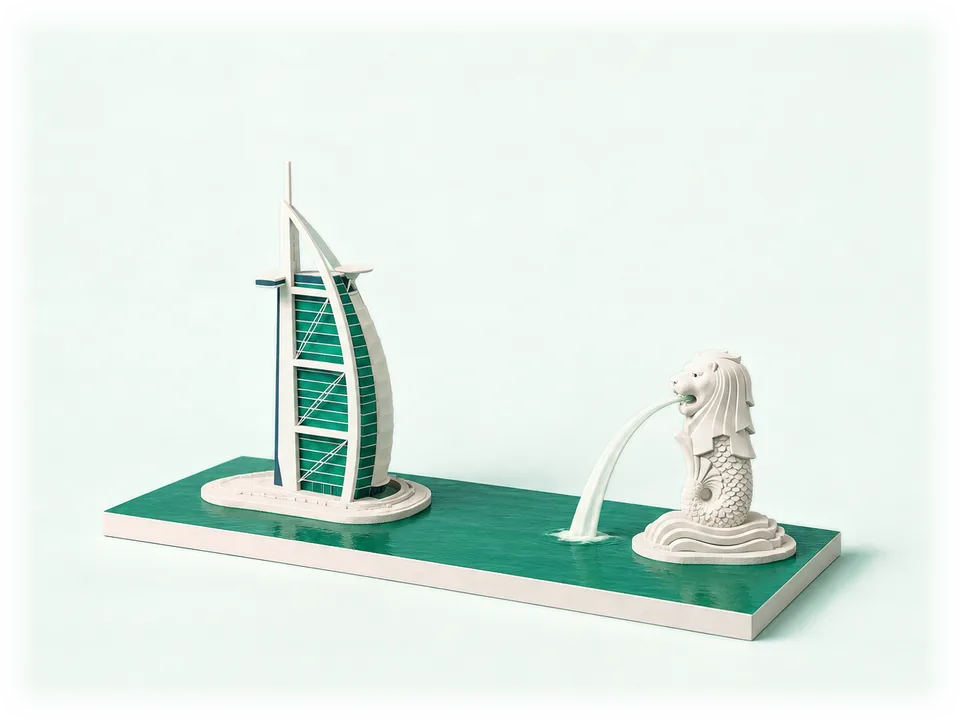
The UAE and Singapore are chosen by entrepreneurs who need a low-tax jurisdiction with a real office, and neither country is an offshore jurisdiction in the classic sense anymore. The UAE levies a federal corporate tax of 9% on profit above AED 375,000, and a free zone company can pay 0% only on qualifying income. Singapore charges 17% and requires a local director and company secretary, so the decision depends on where the team lives and where the clients are.
Comparison at a glance
| Parameter | UAE | Singapore |
|---|---|---|
| Tax authority | Federal Tax Authority (FTA); the law is Federal Decree-Law No. 47 of 2022 | Inland Revenue Authority of Singapore (IRAS) |
| Rate | 0% on profit up to AED 375,000, 9% above that (Cabinet Decision No. 116 of 2022) | 17%; for YA 2026, a 50% CIT Rebate, capped together with the grant at S$40,000 |
| Free zone | Qualifying Free Zone Person (QFZP): 0% on qualifying income, 9% on the rest | the standard rate and IRAS incentives apply |
| Tax registration | free zone companies, including QFZPs, register with the FTA and file a return | tax filings are submitted to IRAS |
| Audit | a QFZP maintains audited financial statements | an auditor is appointed within 3 months unless the company is exempt |
| EU list of October 9, 2026 | not on the list | not on the list |
Tax in the UAE: 9% and free zone conditions
Corporate tax was introduced by Federal Decree-Law No. 47 of 2022. Under Cabinet Decision No. 116 of 2022, the portion of taxable income up to AED 375,000 is taxed at 0%, and income above that amount at 9%.
A free zone company gets the 0% rate only as a Qualifying Free Zone Person (QFZP). According to the Federal Tax Authority (FTA) bulletin, this status requires all of the following at the same time:
- maintaining adequate economic substance in the free zone;
- earning qualifying income;
- not electing the standard tax regime;
- complying with the arm's length principle in related-party transactions and keeping transfer pricing documentation;
- maintaining audited financial statements;
- keeping non-qualifying revenue within the lower of two amounts: AED 5 million or 5% of total revenue (de minimis).
If even one condition is breached, QFZP status is lost from the start of that tax period and for the following four periods. A QFZP's non-qualifying income is taxed at 9%. For details on free zones, see our article on a UAE free zone company. Company forms in the UAE (RAK ICC offshore company, free zones, mainland) and buying a shelf company are covered on the page offshore company in the UAE.
Tax in Singapore: 17% and place of management
IRAS taxes the chargeable income of local and foreign companies at 17%. A company becomes a Singapore tax resident if the control and management of its business are exercised in Singapore, usually where the board of directors meets. A director who is ordinarily resident in Singapore is required under section 145 of the Companies Act 1967, and a company secretary is appointed within six months after registration. For details, see the page company in Singapore.
How to choose
- The team is moving to Dubai and selling services in the region: the UAE, with a license for the activity and a check of the QFZP conditions if income is to be taxed at 0%.
- An office or team in Southeast Asia, investors from the region: Singapore, with a local director and management in the country.
- Trading with China: Hong Kong is worth adding alongside Singapore; see the comparison Hong Kong vs Singapore.
- An IT agency with clients in different countries: see the breakdown in our article on a company for an IT agency.
In both cases, the owner's taxes are determined by the country of their residence: CFC rules, dividend tax and the place of actual management. If the owner lives in a third country and runs the business from there, the company's tax residency may end up there as well.
Banking
For operations in the MENA region, a UAE bank understands the client's business better; for ASEAN markets, a Singapore bank does. In both cases, the bank checks the owners, the license or registration, the office, contracts and the source of funds. We prepare the package in advance under our bank account for an offshore company service.
How the economic substance rules changed in the UAE and how they differ from the island regimes is covered in the guide to economic substance. If a European company is still on your list, see the comparison Estonia or Cyprus.
Send us the type of business, where the owners and team will live, the clients' countries and the expected payments. Offshora will compare the UAE and Singapore by taxes, requirements and budget over two years. Submit a request.
Tell us about your task, and we will propose a jurisdiction, the scope of services and the order of work.
Send a request →Offshore jurisdictions compared · Country comparisons: all articles