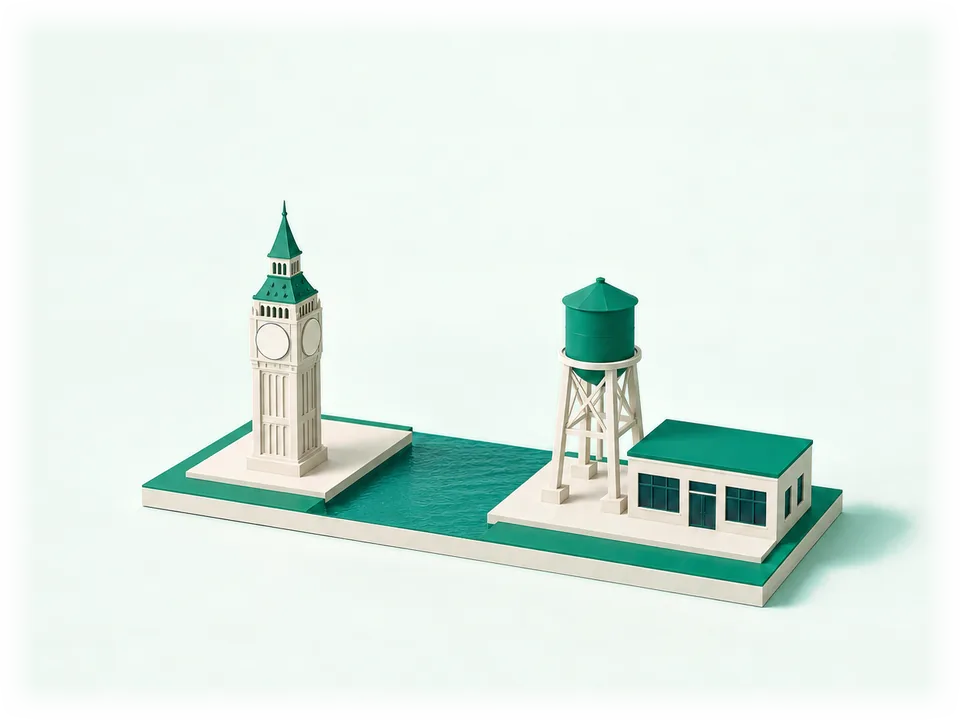
Foreign founders most often compare the British and American forms when they work with Western clients. A UK Ltd is a taxpayer in its own right: it pays Corporation Tax at 19 to 25% and files with Companies House. A US LLC is formed under state law, and its federal tax treatment depends on the number of members and the election made, so with a single foreign owner the tax often arises for the owner personally in their country of residence.
Comparison at a glance
| Parameter | UK Ltd | US LLC |
|---|---|---|
| Governing law | Companies Act, Companies House register | the law of a specific state, such as Delaware or Wyoming |
| Company tax | Corporation Tax: 25%, 19% for profits up to £50,000, Marginal Relief between the thresholds | by default a single-member LLC is a disregarded entity, with two or more members a partnership; Form 8832 lets it elect to be taxed as a corporation |
| Formation | Companies House online fee of £100 | state fee; in Delaware an annual LLC tax of $400 due by June 1 |
| Every year | confirmation statement (£50 online), annual accounts, Company Tax Return | in Delaware an LLC files no annual report; federal forms depend on the classification |
| Foreign owner | directors and PSCs go through identity verification | an LLC with one foreign owner files Form 5472 with a pro forma Form 1120 |
| Ownership disclosure | PSC: more than 25% of shares or votes, control of the board or other significant influence | FinCEN has exempted companies created in the US from BOI reporting |
How a UK Ltd works
A UK company is registered with Companies House, and the online fee for a standard private company registration is £100. The registered office address must be a physical address in the part of the UK where the company is registered, and it is visible on the public register.
Since November 18, 2025, identity verification with Companies House has been a legal requirement. The registration application gives each director's personal code, and existing directors provide their code with the next confirmation statement. A new PSC can provide the code when entered on the register or within 14 days.
Every year the company files a confirmation statement. The first annual accounts are due 21 months after incorporation, and later accounts 9 months after the end of the financial year. Corporation Tax is payable 9 months and 1 day after the end of the accounting period, and the return is filed within 12 months. These obligations apply even to a company with no turnover. Registration and deadlines are covered in detail on the page offshore company in England and UK Ltd.
How a US LLC works
An LLC is formed under state law, and the members' internal rules are set out in an operating agreement. For federal tax purposes the IRS treats a single-member LLC as a disregarded entity by default, meaning its income is attributed to the owner, and an LLC with two or more members as a partnership. For the LLC to be taxed as a corporation, Form 8832 is filed.
For a foreign owner the main obligation is informational. Under the IRS instructions, a US disregarded entity owned by a foreign person files Form 5472 together with a pro forma Form 1120, even when it has no regular tax return to file. Failure to file Form 5472 on time carries an IRS penalty of $25,000. The company keeps records under section 6001 of the Internal Revenue Code.
In Delaware an LLC pays an annual tax of $400 by June 1, and a late payment carries a $200 penalty plus 1.5% per month on the tax and penalty; it files no annual report. Since 2025 FinCEN has exempted all companies created in the US from beneficial ownership information (BOI) reporting; only foreign companies registered to do business in a state file it. How to choose a state is covered in the comparison Delaware vs Wyoming, and formation in the guide US LLC for non-residents.
Where the owner's tax arises
Company tax and the owner's tax are calculated separately. The owner declares dividends from a Ltd in their country of residence. Under the default classification, US federal tax attributes the profit of a single-member LLC to the owner, and the owner's country of residence usually taxes that income as personal income. If the company is in fact managed from another country, the tax residency of the Ltd itself also needs checking. We run the calculation for the owner's country before registration.
Bank, payments and investors
Neither form guarantees an account: the bank or EMI reviews the beneficial owners, client countries, contracts, website and expected payments. For SaaS the key question is whether a payment provider will enable recurring billing for the chosen company; for B2B consulting, whether bank transfers under contract will be enough. Preparation is described in the guide on a bank account for a foreign company.
If a venture round from US funds is planned within a year, study their requirements before registration: such funds often expect a corporation (for example, a Delaware C-Corp), and moving from an LLC will require a reorganization.
How to choose
- An agency or consultant with UK clients, invoicing in pounds: a UK Ltd, a form counterparties understand, with tax paid in the UK.
- A product for US buyers, one foreign owner: a US LLC, if the owner is ready for Form 5472 and for tax on their income at home.
- Plans for venture investment in the US: compare an LLC with a corporation before registration.
For freelancers and consultants, the break-even point of running your own company is worked out in the guide to a company for a freelancer. For a European alternative to both forms, see Estonia or Cyprus; for an offshore one, see offshore or a regular foreign company.
Send us the owner's country of residence, the services or product, client countries, expected payments and investor plans. Offshora will compare both forms for your model and prepare a two-year cost estimate. Submit a request.
Tell us about your task, and we will propose a jurisdiction, the scope of services and the order of work.
Send a request →Offshore jurisdictions compared · Country comparisons: all articles