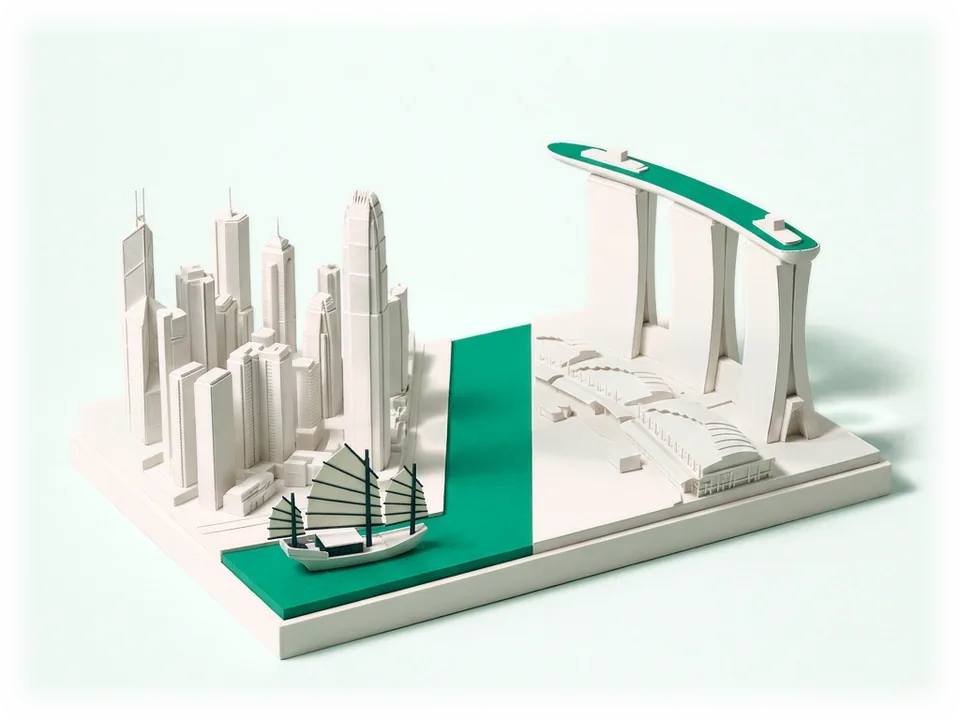
Hong Kong and Singapore are two Asian business hubs that are often called offshore jurisdictions in search results, although both levy tax on profits and require annual reporting. Hong Kong taxes only Hong Kong-sourced profits and is usually more convenient for trade with China. Singapore charges 17% and requires a local director, but it suits a regional team and a headquarters in Southeast Asia.
Comparison at a glance
| Parameter | Hong Kong | Singapore |
|---|---|---|
| Tax on profits | 8.25% on the first HK$2 million, 16.5% above that; Hong Kong-sourced profits are taxed | 17% on chargeable income; for YA 2026, a 50% CIT Rebate, with a combined cap of S$40,000 including the grant |
| Foreign income | as a general rule, not taxed; the FSIE regime applies to multinational groups | tax residency is determined by the place of control and management |
| Director | at least one director who is an individual, no requirement to live in Hong Kong | at least one director ordinarily resident in Singapore (section 145 of the Companies Act 1967) |
| Company secretary | mandatory: a local resident or a company with a local office | appointed within 6 months and must meet the local residency requirements |
| Annual return to the registry | NAR1 within 42 days after the incorporation anniversary, fee HK$105 | annual return to ACRA through BizFile |
| EU list of October 9, 2026 | not on the list | not on the list |
Taxes: the territorial principle vs a 17% rate
Hong Kong’s tax authority (the Inland Revenue Department) taxes profits that arise in its territory or are derived from a Hong Kong source. The source is determined by the facts: where contracts were concluded, where the work was performed and who made the decisions. Since January 1, 2023, the FSIE regime has applied to members of multinational groups: foreign-sourced interest, dividends, income from intellectual property and gains from the disposal of equity interests received in Hong Kong are taxed if the company does not meet the exemption conditions; since 2024, the regime has covered gains from the disposal of any property.
IRAS taxes the chargeable income of local and foreign companies at 17%. A company becomes a Singapore tax resident if the control and management of its business are exercised in Singapore; a company managed from another country is treated as a non-resident. How the place of management affects taxes in different countries is covered in the article on corporate tax residency.
Director, company secretary and running costs
In Hong Kong, the director can live in any country, while the company secretary and the registered office must be local. Singapore requires a director ordinarily resident in the country and a local company secretary, so a non-resident founder’s budget includes nominee director and company secretary services from the start. In Singapore, an auditor is appointed within three months after incorporation unless the company qualifies for an exemption. On the day of incorporation, a nominee director in Singapore informs the company of their status and of the person who nominated them.
The Companies Registry government fee for electronic incorporation of a private company in Hong Kong is HK$1,545, and HK$1,720 on paper. The two-year budget for both countries is made up of government fees, the company secretary, the address, accounting, tax reporting, an audit where required and banking costs. A separate review is in the article on the total cost of a foreign company.
How to choose
- Sourcing from factories in China, intermediation in B2B deals with Asia: more often Hong Kong; details on the Hong Kong offshore company page.
- A team or office in Southeast Asia, investors, a regional headquarters: more often Singapore; details on the Singapore company page.
- The founder lives in Europe and sells to EU clients: both countries add costs without a tax effect; compare them with operating jurisdictions in the offshore jurisdictions section.
- Choosing between Singapore and Dubai: see the separate comparison UAE vs Singapore.
Bank
In both jurisdictions, the bank looks at the company’s connection with the region. A trading company in Hong Kong will be asked about contracts with the factory and the buyer and the route of goods and payments; a Singapore startup, about its business plan, founders and the role of the local team. Company registration does not guarantee an account, so we prepare the package in advance under the bank account for an offshore company service.
How to build a supply chain with a Hong Kong intermediary is covered in the guide to a company for international trade. How the territorial and onshore models differ from a classic offshore company is explained in offshore or a regular foreign company.
Send us a description of the business, the countries of clients and suppliers, the owners’ residency and the expected payments. Offshora will compare Hong Kong and Singapore on taxes, requirements and a two-year budget. Send a request.
Tell us about your task, and we will propose a jurisdiction, the scope of services and the order of work.
Send a request →Offshore jurisdictions compared · Country comparisons: all articles